8 Types of Toxic Bosses (And How to Document Each One)
The Free Pattern Tracker (PDF)
A one-page log: date, exact quote, the flip, your reaction. Print it, fill it in, keep it somewhere safe.
- Free workplace incident-log sample
- Completed example — fictional
- 1. The Goalpost Shifter
- 2. The Gaslighter
- 3. The Isolator
- 4. The Credit Thief
- 5. The Public Humiliator
- 6. The Favoritism Player
- 7. The Retaliator
- 8. The Micromanaging Controller
- Why Naming the Specific Pattern Matters
- General Documentation Principles That Apply Across All Eight Types
- Frequently Asked Questions
- What the full workplace kit adds
Free workplace incident-log sample
Start with one incident. This free, fillable one-page PDF has fields for date, time, location, people present, observed facts, work impact, supporting record references, and follow-up. Download directly; no email required.
Completed example — fictional
Date/time: September 21, 10:15 a.m. Location: Team meeting. People present: Manager, me, two colleagues. Observed facts: The September 18 project brief requested a two-page summary. I delivered two pages at 9 a.m. Today the manager said, “This needed to be five pages.” Work impact: The review was postponed. Record reference: Original brief in the approved project system. Follow-up: Ask for the revised scope and deadline in writing.
This is an example of a factual entry, not proof of motive or a legal conclusion.
Quick answer: Toxic bosses tend to fall into recognizable patterns rather than being uniquely difficult in unpredictable ways. Naming the specific pattern — goalpost shifter, gaslighter, isolator, credit-stealer, and others below — makes it much easier to know exactly what to document and how to protect yourself.1. The Goalpost Shifter
This manager changes expectations after work is already completed, so that no amount of effort is ever quite sufficient. A project meets the original brief, and suddenly the brief "was always" something slightly different. Over time, this creates a work environment where it's impossible to ever feel secure in having done a good job.What to document: Save the original instructions or brief in writing — email, chat message, meeting notes — every time. When expectations shift after the fact, note the date and exact wording of both the original ask and the new one, side by side.2. The Gaslighter
This manager denies previous instructions, commitments, or conversations, often confidently enough to make you doubt your own memory. "I never said that" or "that's not what we agreed" becomes a recurring pattern, particularly around anything that would reflect poorly on them.What to document: Follow every verbal conversation with a same-day email summarizing what was discussed and agreed ("Just to confirm from our conversation today..."). This creates a written record without requiring the manager to respond, and records your understanding; silence does not establish that the recipient agrees.3. The Isolator
This manager works to cut you off from allies, information, or visibility — excluding you from meetings you should be part of, routing information around you, or subtly discouraging your relationships with other colleagues or higher-ups who might otherwise notice a pattern of mistreatment.What to document: Keep a record of meetings, distribution lists, or decisions you were excluded from that you had a legitimate role in. Note the pattern over time rather than any single exclusion, since isolation usually escalates gradually.4. The Credit Thief
This manager takes credit for your work, ideas, or solutions, presenting them upward as their own while your actual contribution goes unacknowledged, especially in high-visibility moments like leadership presentations.What to document: Timestamp your work and ideas in writing before presenting them to your manager — a dated email, a shared document with edit history, a project management tool with a clear timeline. This creates an independent record that predates any later claim of ownership.5. The Public Humiliator
This manager criticizes, corrects, or belittles you in front of others — meetings, group chats, or open office settings — rather than addressing concerns privately, using public embarrassment as a control tactic.What to document: Note the date, setting, who else was present, and as close to verbatim wording as possible immediately after each incident. Witnesses matter significantly here — if colleagues are willing to corroborate what they observed, that independent confirmation is valuable.6. The Favoritism Player
This manager applies rules, opportunities, and consequences inconsistently across the team, favoring certain employees while holding others to a different, harsher standard for identical behavior or performance.What to document: Track specific instances where comparable work, behavior, or circumstances were treated differently — dates, what happened, and who was involved. Patterns of inconsistency are far more persuasive than a single instance of unfairness.7. The Retaliator
This manager responds to complaints, boundary-setting, or HR involvement with subtle (or not-so-subtle) punishment — reduced opportunities, sudden negative performance reviews, exclusion from projects — timed closely enough after the complaint to suggest a connection, even if never stated outright.What to document: Note the exact date of any complaint or boundary you raised, and then track any negative changes in treatment, opportunities, or feedback that follow, with dates. Timing is often the most important piece of evidence in a retaliation pattern.8. The Micromanaging Controller
This manager exerts excessive, often demeaning control over minor details of your work, communicating a fundamental lack of trust regardless of your track record, and often shifting the specific area of "concern" whenever one area is addressed.What to document: Keep a record of your actual output and outcomes over time, independent of the manager's moment-to-moment feedback, so you have an objective record of your performance that isn't filtered entirely through their shifting concerns.Why Naming the Specific Pattern Matters
Toxic workplace behavior often gets addressed too generally — "my boss is difficult" doesn't give HR, a future employer, or even yourself much to actually act on. Naming the specific pattern (retaliation, credit theft, gaslighting) points directly to what needs to be documented and what a resolution would even look like. It also helps you recognize when multiple patterns are happening simultaneously, which is common — a boss who isolates you is also often the one who takes credit for your work, since isolation reduces the witnesses who might notice.General Documentation Principles That Apply Across All Eight Types
- Write things down close to when they happen, not reconstructed from memory weeks later.
- Protect your personal notes and respect confidentiality — check applicable workplace policies and obtain qualified advice before copying or forwarding restricted material. Do not automatically send work emails to a personal account.
- Save original documents and communications rather than paraphrasing them.
- Note witnesses whenever incidents happen in front of others.
- Track patterns over time, not just individual incidents — a dated log makes an emerging pattern visible in a way scattered memory can't.
Frequently Asked Questions
Should I confront my boss directly about a pattern I've noticed? This depends heavily on the specific situation and workplace culture — sometimes direct, calm conversation resolves things; other times it triggers retaliation. A factual record can help you organize your concerns, but it cannot guarantee protection or a particular response.Is it legal to keep a private log of my boss's behavior? This guide cannot determine what is permitted in your situation. Check applicable workplace policies and obtain qualified advice before recording conversations or copying confidential material.How much documentation is actually needed before going to HR? More is generally better, but even a few clearly dated, specific incidents are more useful than a vague, general complaint. Focus on quality and specificity over sheer volume.What if my company culture makes multiple bosses toxic in different ways? Document each pattern separately, even if they involve overlapping incidents — this makes it easier to show the full scope if you eventually need to escalate.Can these patterns overlap in one person? Yes, frequently — a single difficult manager often displays several of these patterns simultaneously, which is exactly why naming each one specifically, rather than treating it as one vague "toxic boss" problem, is useful.What the full workplace kit adds
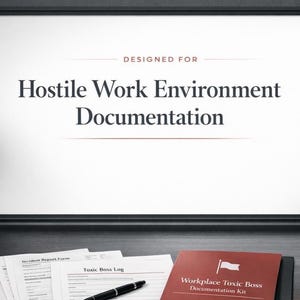
The Etsy listing includes five core tools: a Workplace Incident Log, HR Complaint Tracker, Witness Log, Pattern Analysis Page, and Documentation Protocol Guide. View the listing for the actual product previews and current purchase details.
Return to the Workplace hub · Download another blank incident-log sample
Discover more from Red Flag Archive
Subscribe to get the latest posts sent to your email.
Turn the pattern into proof.
Track what happened, what changed, and what keeps repeating—without second-guessing yourself later.